
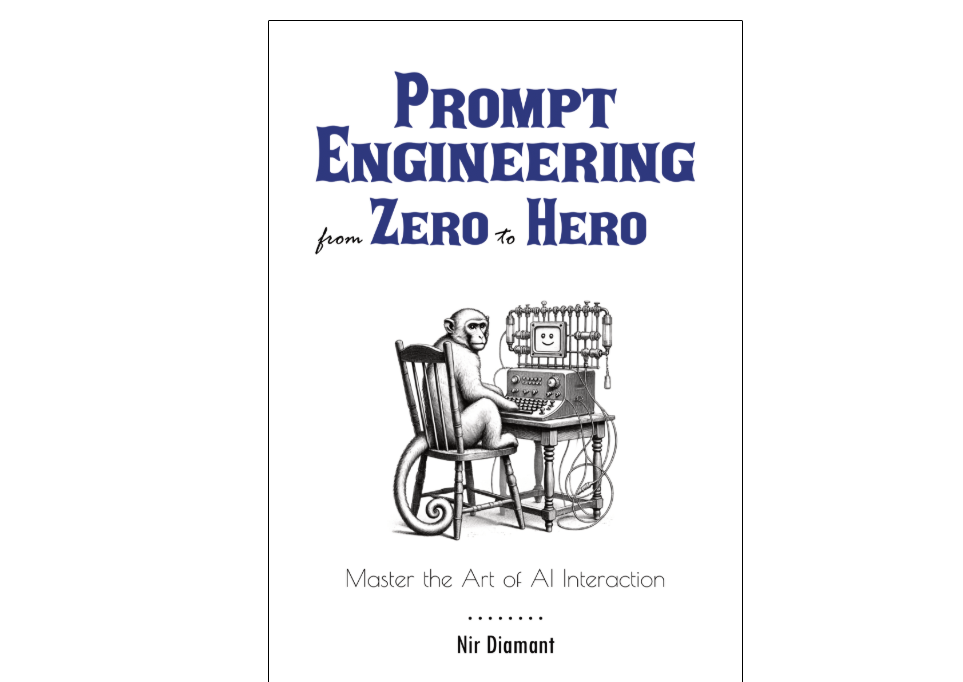
Nir Diamant – Prompt Engineering from Zero to Hero
$59.00 Original price was: $59.00.$21.00Current price is: $21.00.
- 24/7 Contact Support & Telegram - Ecomkevin_1
- You Can Request Any Courses
- Original Courses HD Qualite and links updated
Guaranteed Safe Checkout


Nir Diamant – Prompt Engineering from Zero to Hero Review: The Definitive Deep-Dive
As generative artificial intelligence transforms industries, the ability to effectively communicate with Large Language Models (LLMs) has shifted from a novel skill into a core professional competency. However, many developers, AI enthusiasts, and business leaders struggle to move beyond basic zero-shot prompts, frequently encountering hallucinations, inconsistent outputs, and non-deterministic results.
To bridge this gap between casual AI interactions and enterprise-grade prompt architecture, Nir Diamant – Prompt Engineering from Zero to Hero has gained significant attention across the developer and AI communities. Designed as a comprehensive, hands-on masterclass, this curriculum aims to transform beginners into proficient prompt engineers capable of orchestrating complex AI workflows.
This exhaustive review provides an honest, unstructured look at the program’s design, core methodologies, practical applications, potential limitations, and final verdict to help you determine if this training lives up to its reputation.
What Is Nir Diamant – Prompt Engineering from Zero to Hero?
Nir Diamant – Prompt Engineering from Zero to Hero is an in-depth, production-focused repository and training guide centered on mastering communication with LLMs. Unlike surface-level tutorials that offer simple “cheat sheets” or copy-paste templates, this program delves into the underlying mechanics of modern language models, tokenization, contextual constraints, and structural prompt design.
The course bridges theoretical machine learning principles with practical software engineering application. It equips users with structured frameworks to reliably control AI responses, systematically audit outputs, and seamlessly integrate LLM components into real-world software applications and business pipelines.
Basic AI Prompting Route:
[Simple Text Query] ➔ [Unpredictable LLM Output] ➔ [Manual Edits & Re-prompting]

Engineered Prompting Pipeline:
[System Persona & Context] ➔ [Structured Data Constraints] ➔ [Chain-of-Thought Guardrails] ➔ [Deterministic & Production-Ready Output]
Core Modules and Learning Architecture
1. Fundamentals of Large Language Model Communication
The introductory modules establish the technical foundation required to understand how language models process inputs. Lessons cover token management, context windows, temperature settings, top-p sampling, and system message hierarchy—ensuring learners understand the knobs and levers that dictate AI behavior.
2. Basic to Intermediate Prompting Techniques
Moving past simple queries, this section covers foundational techniques used to refine output accuracy:
-
Zero-Shot vs. Few-Shot Prompting: Harnessing in-context learning by providing targeted examples within the prompt.
-
Role and Persona Assignment: Setting specific operational boundaries and domain expertise profiles for the model.
-
Format Control: Enforcing explicit output structures like JSON, XML, Markdown, or custom key-value pairs.
3. Advanced Reasoning Frameworks
The core highlight of the program is its focus on complex reasoning techniques. It provides step-by-step breakdowns of:
-
Chain-of-Thought (CoT): Forcing models to show intermediate reasoning steps before arriving at a final answer, drastically reducing logical errors in math and code.
-
Tree-of-Thoughts (ToT): Structuring prompts that allow LLMs to explore multiple solution pathways simultaneously before selecting the optimal route.
-
Self-Consistency and Generated Knowledge: Implementing self-correction loops to verify factual claims before final output generation.
4. Guardrails, Safety, and System Integrity
Production LLM deployments require robust safety measures. This module focuses on prompt injection defense, system prompt leak prevention, output verification tactics, and crafting robust fallback routines for edge cases.
5. Automated Evaluation and Pipeline Integration
The final section transitions from manual prompt tuning to programmatic evaluation. Learners discover how to test prompts systematically against datasets, measure semantic similarity, evaluate outputs using LLM-as-a-Judge frameworks, and integrate optimized prompts into application workflows.
Key Highlights & Standout Strengths
-
Engineering-First Approach: Focuses on deterministic, reliable, and production-ready techniques rather than theoretical fluff or generic cheat sheets.
-
Comprehensive Progression: Smoothly transitions learners from absolute zero knowledge to complex multi-step reasoning architectures.
-
Rich Practical Examples: Features hands-on code snippets, structured JSON schemas, and clear real-world deployment scenarios.
-
Emphasis on Edge Cases: Spends significant time on error handling, preventing model hallucinations, and defending against adversarial prompt injections.
Potential Limitations to Keep in Mind
-
Technical Depth: Non-technical learners or total beginners without prior exposure to software concepts may experience a slight learning curve during programmatic evaluation modules.
-
Fast-Evolving Field: As underlying foundation models advance, hyper-specific workaround techniques must be continuously updated to align with new model architectures.
-
Requires Active Experimentation: Mastering these strategies demands hands-on testing, API key usage, and iterative practice alongside the material.
Comparison: Casual Prompting vs. Engineered Prompt Systems
| Evaluation Metric | Casual AI Prompting | Engineered Prompt Systems |
|---|---|---|
| Output Consistency | Highly variable; unpredictable formatting | Deterministic; standardized JSON/XML structures |
| Reasoning Accuracy | Prone to logical gaps on complex tasks | High accuracy via Chain-of-Thought and verification loops |
| Error Handling | Requires manual user intervention | Automated fallback rules and guardrails |
| Production Readiness | Suitable only for ad-hoc personal tasks | Scalable for direct software and API integration |
Who Should Take This Course?
-
Software Engineers & AI Developers: Professionals integrating LLMs into web apps, microservices, or enterprise pipelines who require structured, reliable outputs.
-
Product Managers & AI Strategists: Leaders designing AI-powered features who need to understand technical feasibility, constraints, and cost optimization.
-
Power Users & Automators: Solopreneurs and tech enthusiasts looking to build complex, automated workflows using modern AI platforms.
Final Verdict
Nir Diamant – Prompt Engineering from Zero to Hero stands out as an exceptional, highly practical resource for anyone serious about mastering generative AI. By emphasizing production-grade techniques, structured guardrails, and advanced reasoning frameworks, it successfully elevates prompt design from a trial-and-error visual art into a disciplined engineering practice. For developers and tech professionals seeking total control over modern LLM outputs, this training provides immense, long-term value well worth the investment.
