
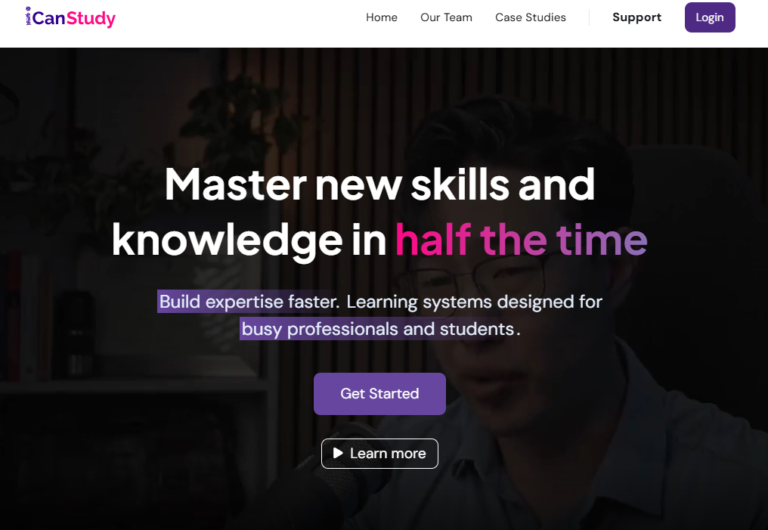
Justin Sung – iCanStudy (September 2026)
$169.00 Original price was: $169.00.$35.00Current price is: $35.00.
- 24/7 Contact Support & Telegram - Ecomkevin_1
- You Can Request Any Courses
- Original Courses HD Qualite and links updated
Guaranteed Safe Checkout


Justin Sung – iCanStudy : An Honest, In-Depth Review
Most study advice on the internet follows the exact same formula: download an spaced repetition app like Anki, build thousands of flashcards, use the Pomodoro technique, and power through long study sessions. While these methods might yield short-term results for simple memorization, they often break down when students face complex, highly conceptual coursework.
This brings us to Justin Sung – iCanStudy , a comprehensive learning system designed to shift students away from mechanical repetition and toward deep, cognitive understanding. Created by Dr. Justin Sung, a former physician and prominent learning strategist, the program claims to revolutionize how we process, retain, and retrieve information.
In this detailed review, we examine the core philosophy of the system, evaluate its September 2026 updates, break down its structure, and discuss whether it is worth your time and financial investment.
What Is the iCanStudy System?
At its core, Justin Sung – iCanStudy (September 2026) is not just a collection of surface-level study hacks. It is a structured curriculum focused on meta-learning—the science of understanding how your brain processes information so you can optimize learning efficiency.
Unlike traditional courses that emphasize memorization techniques, this system focuses heavily on cognitive load management, conceptual synthesis, and self-regulated learning. The goal is simple: reduce the total number of hours you spend studying while simultaneously increasing your comprehension and long-term retention.
Key Pillars of the Methodology
-
Deep Processing: Shifting away from passive reading and mechanical note-taking toward active organizational structures that force the brain to evaluate relationships between concepts.
-
Higher-Order Mind Mapping: Moving past traditional linear notes and basic mind maps to create multi-layered, highly interconnected visual structures.
-
Cognitive Load Optimization: Structuring study sessions to prevent mental exhaustion and burnout, allowing for high-efficiency learning over extended periods.
-
Self-Regulated Learning (SRL): Developing internal feedback loops so learners can diagnose their own weaknesses and adjust their study methods in real time.
What’s New in the September 2026 Update?
The Justin Sung – iCanStudy (September 2026) edition builds upon previous iterations of the curriculum, refining the framework to account for modern academic and professional demands. Over time, the course has evolved from a linear set of video modules into a fully dynamic ecosystem.
Key Enhancements in This Version:
-
Refined Mapping Frameworks: Updated guidelines for building higher-order mind maps that reduce the friction beginners often experience when transitioning from traditional note-taking.
-
Streamlined Pre-Assessment Modules: Enhanced diagnostic tools at the start of the course to help users identify their specific cognitive bottlenecks faster.
-
Updated Practical Case Studies: Real-world examples across diverse fields—including medicine, law, engineering, computer science, and language learning—demonstrating how to apply deep processing techniques to non-standard curricula.
-
Optimized Exercise Worksheets: Practical, step-by-step assignments redesigned to give immediate feedback on whether you are using surface-level or deep-level processing.
Detailed Module Breakdown
The curriculum is structured progressive-style, meaning each concept builds directly upon the previous one. You cannot simply jump straight into advanced speed reading or memory techniques; the foundation must be built first.
Module 1: Unlearning Counterproductive Habits
The majority of students enter the course relying on passive re-reading, highlighting, and mechanical flashcards. This initial phase breaks down why these habits create an illusion of competence and sets the baseline metrics for tracking your actual learning speed and comprehension.
Module 2: The Principles of Deep Processing
This phase introduces the core mechanics of how the brain encodes complex information. You learn how to convert unstructured data (textbooks, lectures, research papers) into structured relationships. Rather than trying to remember facts in isolation, you learn how to connect them logically.
Module 3: Higher-Order Relationship Mapping
Mind mapping in this course is drastically different from the generic bubble diagrams taught in primary school. Here, mapping is used as an active thinking tool rather than a storage mechanism. You learn how to map concepts based on hierarchy, causality, contrast, and function.
Module 4: Managing Cognitive Load and Focus
Even the best study techniques fail if fatigue sets in. This module covers practical strategies for maintaining high levels of focus without relying on artificial pressure or unsustainable marathon study sessions.
Module 5: Retrieval Dynamics and Exam Preparation
Instead of relying purely on passive review or repetitive flashcard testing, this section teaches dynamic retrieval. You learn how to test your understanding under exam-like conditions using your concept maps, forcing your mind to reconstruct complex topics from memory.
Who Is This Course Best Suited For?
While the course offers immense value, it is not a universally effortless solution for everyone. Understanding who benefits most helps set realistic expectations.
Ideal Candidates:
-
Medical, Law, and STEM Students: Those dealing with high volumes of complex, interrelated information that cannot be mastered through simple rote memorization.
-
Self-Directed Learners and Professionals: Professionals pursuing complex certifications, coding bootcamps, or continuous professional development who need to absorb vast amounts of knowledge quickly.
-
Students Experiencing Academic Plateaus: Learners who are working hard and putting in long hours but have hit a performance ceiling despite using standard study techniques.
Who Might Struggle:
-
Students Looking for Quick Hacks: If you want a quick trick to pass an exam tomorrow morning, this course will not fulfill that expectation. It requires deliberate effort to unlearn old habits and build new cognitive pathways.
-
Those Needing Simple Fact Memorization: If your coursework consists entirely of straightforward, single-line vocabulary definitions, traditional spaced repetition tools may already meet your needs.
Strengths and Potential Drawbacks
Strengths
-
Root-Cause Focus: Addresses the fundamental mechanisms of how humans learn rather than offering surface-level fixes.
-
Broad Applicability: The core framework works across nearly every academic discipline and professional domain.
-
High ROI on Time: Once fully mastered, the system significantly reduces total study time while improving long-term retention and conceptual clarity.
-
Structured Community Support: Access to workshops, community feedback, and guided assessments helps ensure you apply the techniques correctly.
Drawbacks
-
Steep Initial Learning Curve: Transitioning from traditional note-taking to higher-order mapping requires patience and initial cognitive friction.
-
Time Investment Required: You must spend time learning how to study before you see drastic improvements in your actual subject matter study sessions.
Is Justin Sung – iCanStudy (September 2026) Worth It?
If you are struggling under the weight of massive content volumes, feeling burned out by endless flashcards, or simply reaching the limits of standard study techniques, Justin Sung – iCanStudy (September 2026) offers a practical, science-backed path forward.
It is not a magic solution that eliminates hard work, nor does it promise effortless success overnight. However, for dedicated students and lifelong learners who are willing to put in the initial effort to restructure their cognitive habits, the return on investment in saved study time, reduced stress, and increased comprehension is undeniable.
Final Verdict
Rating: 4.8 / 5.0
Bottom Line: A world-class meta-learning program that delivers exceptional value for learners tackling complex, high-density subjects. If you are ready to invest time into upgrading your study methodology, this system remains one of the most comprehensive learning frameworks available today.
