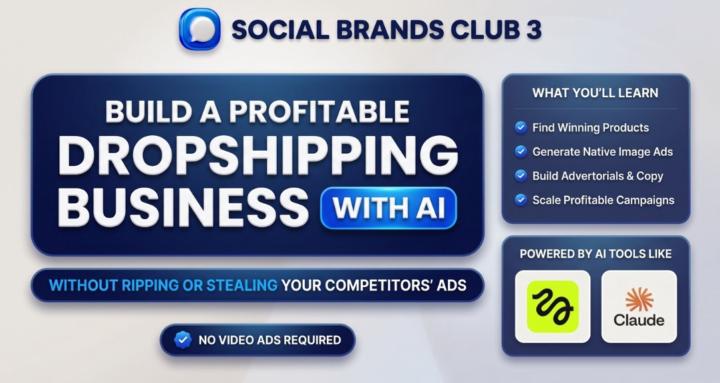
Alex Robinson – Social Brands Club 3.0 (September 2026)
$129.00 Original price was: $129.00.$35.00Current price is: $35.00.
- 24/7 Contact Support & Telegram - Ecomkevin_1
- You Can Request Any Courses
- Original Courses HD Qualite and links updated
Guaranteed Safe Checkout


Alex Robinson – Social Brands Club 3.0 : An Honest, In-Depth Review
Navigating the landscape of social media branding and digital marketing in 2026 requires strategies that go beyond basic content scheduling or outdated ad tactics. As platforms evolve and consumer attention spans shorten, creator-led and brand-centric marketing models have taken center stage. Among the recent updates gaining traction in this space is Alex Robinson – Social Brands Club 3.0
Designed to serve as a blueprint for entrepreneurs, content creators, and agency owners, this updated iteration promises modern frameworks for launching, scaling, and monetizing digital brands. But does the course deliver enough tangible value to justify the time and investment?
This comprehensive review breaks down the structure, core teachings, strengths, weaknesses, and overall value of the program to help you determine if it aligns with your brand goals.
What Is the Core Concept Behind the Program?
At its foundation, the program focuses on transforming modern social media traffic into sustainable, revenue-generating brands. Rather than relying solely on short-term direct-response ads or organic virality, the curriculum emphasizes building structured media assets.
The September 2026 update specifically addresses recent algorithmic shifts across major visual and short-form platforms, integrating multi-channel attribution strategies and community-driven audience retention models.
Key Objectives
-
Building brand authority from scratch using short-form and long-form video funnels.
-
Scaling customer acquisition without over-relying on paid ad budgets.
-
Structuring back-end monetization to maximize lifetime customer value (LTV).
-
Leveraging modern workflow tools and automation to streamline content production.
Comprehensive Module Breakdown
The curriculum is structured into sequential modules designed to take a learner from foundational brand strategy to advanced operational scaling.
Module 1: Brand Positioning & Market Validation
The introductory module centers on finding high-margin niches and validating brand offers before producing assets.
-
Identifying unsaturated market segments using real-time social listening techniques.
-
Crafting a unique brand narrative that differentiates your business from generic competitors.
-
Establishing customer personas based on actual buying psychology rather than demographics alone.
Module 2: The Modern Content Blueprint
Content creation remains a core pillar of the course, with a heavy emphasis on efficiency and scalable media output.
-
Developing short-form video frameworks tailored for high retention and algorithm push.
-
Setting up batch-production systems to generate high-volume creative assets without burning out.
-
Storyboarding techniques designed to convert casual viewers into long-term community members.
Module 3: Organic Traffic & Platform Distribution
Rather than spreading efforts thin across every available channel, this module teaches strategic platform dominance.
-
Platform-specific distribution mechanics updated for current visual feeds.
-
Organic funnel architecture: routing social traffic directly into owned media lists (email/SMS).
-
Community building techniques that foster high engagement and organic brand advocacy.
Module 4: Paid Media Integration & Scaling Funnels
Once organic distribution is established, the course introduces paid acquisition frameworks.
-
Testing ad creatives cost-effectively before scaling ad spend.
-
Blending user-generated content (UGC) with structured sales pages for maximum conversion.
-
Retargeting strategies designed to recapture cold traffic across multiple touchpoints.
Module 5: Operations, Systems & Long-Term Monetization
The final section transitions from audience growth to operational sustainability.
-
Standard Operating Procedures (SOPs) for outsourcing content editing and community management.
-
Back-end monetization strategies, including subscription models, digital products, and physical merchandise.
-
Managing cash flow and profit margins while scaling brand operations.
Key Highlights & Standout Features
1. Updated for Current Industry Trends
Many digital marketing courses quickly become obsolete as platforms change their algorithms and ad policies. The September 2026 framework incorporates current platform realities, focusing heavily on authentic, human-centric messaging over overly polished, commercial-style ads.
2. Practical Action Steps Over Abstract Theory
Instead of offering high-level advice, the modules include actionable checklists, workflow templates, and creative scripts. Learners receive clear instructions on what steps to execute at each stage of brand development.
3. Emphasis on Owned Media
A major strength of the curriculum is its persistent focus on converting temporary social followers into owned digital assets (email subscribers and private communities). This protects brands from sudden algorithm changes or account disruptions.
Potential Drawbacks to Consider
While the course offers substantial value, it may not be the perfect fit for every creator or marketer.
-
Requires High Execution Energy: Building a functional brand using these methodologies involves consistent content production, video filming, and active testing. It is not a hands-off or automated “get rich quick” system.
-
Steep Learning Curve for Complete Beginners: Individuals with zero prior experience in basic video editing, copywriting, or fundamental marketing terminology may need extra time to get up to speed with the software tools recommended.
-
Time-Intensive Setup: Setting up the proper funnel architecture, email sequences, and asset pipelines requires significant upfront effort before seeing initial results.
Who Is This Program Best Suited For?
| User Profile | Suitability Level | Why? |
|---|---|---|
| E-commerce Brand Owners | High | Provides clear frameworks for lowering customer acquisition costs via organic media. |
| Content Creators | High | Helps transition from relying on brand deals to owning independent, monetizable brand assets. |
| Digital Agency Founders | Medium-High | Offers modern content distribution SOPs that can be implemented for client accounts. |
| Absolute Beginners | Moderate | Valuable concepts, but requires dedication to learn foundational tools along the way. |
Pros and Cons Summary
Pros
-
Comprehensive coverage of both organic reach and paid acquisition.
-
Clear, actionable SOPs and visual funnels ready for implementation.
-
Strong focus on building long-term brand equity rather than short-sighted tactics.
-
Realistic view of the effort required to build a sustainable digital business.
Cons
-
Demands consistent output and field testing from the student.
-
Can feel overwhelming if attempted all at once without a clear daily execution plan.
Final Verdict
Alex Robinson – Social Brands Club 3.0 ( ) offers a practical, highly detailed blueprint for anyone serious about building a modern, media-driven business. By bridging the gap between creative content production and systematic conversion funnels, it addresses the exact challenges digital brands face today.
If you are looking for a magic-bullet solution that requires minimal effort, this course will likely prove demanding. However, if you are willing to execute the frameworks, build the content systems, and stay consistent with platform strategies, it stands as one of the more thorough and up-to-date resources available for brand builders.
Overall Rating: 4.5 / 5
