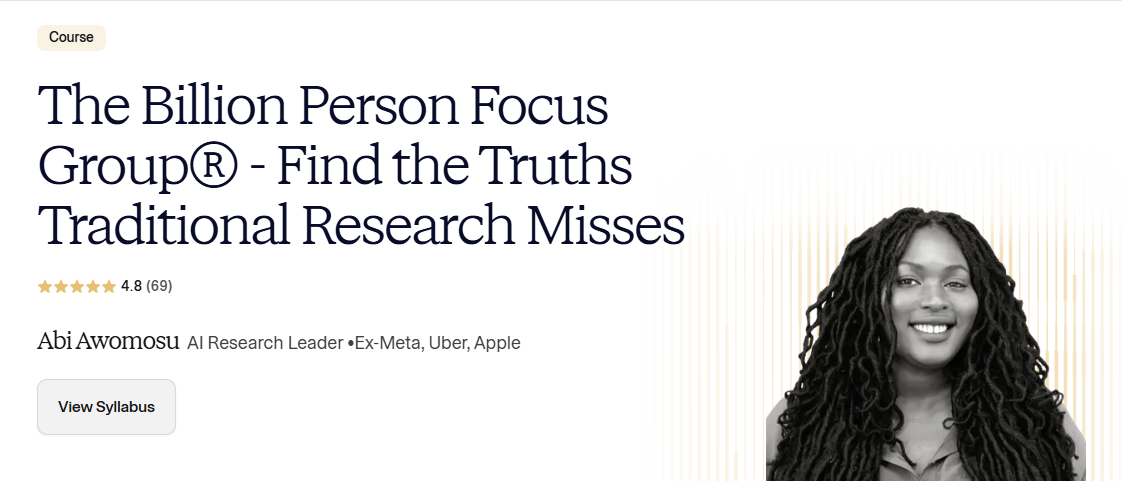
Abi Awomosu – The Billion Person Focus Group
$1,198.00 Original price was: $1,198.00.$45.00Current price is: $45.00.
- 24/7 Contact Support & Telegram - Ecomkevin_1
- You Can Request Any Courses
- Original Courses HD Qualite and links updated
Guaranteed Safe Checkout


Abi Awomosu – The Billion Person Focus Group: An In-Depth Review
Understanding customer intent, regional nuance, and cultural nuances at scale is one of the greatest challenges facing modern strategists, marketers, and product innovators. Large-scale focus groups historically required immense capital, strict geographic boundaries, and weeks of tedious data synthesis. Abi Awomosu – The Billion Person Focus Group presents a disruptive methodology designed to solve this exact problem, bridging the gap between localized qualitative insights and global quantitative reach.
In this comprehensive review, we will deconstruct the concepts, strategies, and overall utility of this framework to help you determine whether it lives up to the hype and how it can be applied to real-world business challenges.
1. What Is the Core Concept?
At its foundation, the framework redefines how organizations collect, interpret, and action human feedback. Rather than relying on traditional, small-sample qualitative panels—which often suffer from observer bias, geographical constraints, and high drop-off rates—this approach treats digital networks and global data streams as a continuous, organic panel.
The central premise revolves around three core pillars:
-
Passive vs. Active Synthesis: Shifting from artificial Q&A setups to observing real-world behavioral signals across diverse channels.
-
Scale Without Noise: Filtering out internet chatter to isolate genuine consumer pain points, desires, and implicit preferences.
-
Culturally Aware Scaling: Ensuring that scaling an idea to a global audience does not erase the localized context necessary for localized adoption.
By structuring market research around these principles, the model aims to provide teams with real-time feedback loops that mirror the sheer scale of global user populations.
2. Key Frameworks and Methodologies
A. The Signal Filtering Architecture
One of the most impressive aspects detailed within the material is the structural approach to data filtering. Raw data at a massive scale is inherently noisy. The framework introduces a systematic method for categorizing feedback into distinct tiers:
-
Explicit Feedback: Direct reviews, survey responses, and active comments.
-
Implicit Signals: Search trends, drop-off points, interaction velocity, and navigation habits.
-
Contextual Drivers: Cultural events, macroeconomic conditions, and localized trends influencing user sentiment.
By establishing strict criteria for filtering noise, the methodology prevents “data overload” and focuses strictly on actionable intelligence.
B. Scaled Persona Aggregation
Traditional buyer personas are often static, outdated documents that sit in shared drives. The method outlined by Abi Awomosu reimagines personas as dynamic, evolving models. Instead of creating fixed archetypes (e.g., “Tech-Savvy Marketing Mary”), it groups behaviors into dynamic sentiment clusters that update as consumer attitudes shift.
3. Practical Applications and Real-World Use Cases
To evaluate the utility of any business methodology, one must look at how easily it translates into daily execution. Here is how different disciplines can apply these insights:
Product Development & Innovation
Product teams frequently struggle with feature prioritization. By using the filtering mechanics taught in this framework, product managers can validate product-market fit prior to writing code. Instead of guessing feature priority based on a sample size of 10-15 interviewees, product leads can cross-reference feature demand across thousands of implicit touchpoints.
Brand Positioning and Marketing
Marketing campaigns fail when they misread customer sentiment or use language that feels disconnect from real user experiences. Applying this system allows brand strategists to extract the exact lexicon, metaphors, and pain points used by their target audience, ensuring ad copy and positioning resonate instantly.
4. Comprehensive Strengths vs. Areas for Improvement
To ensure an honest evaluation, it is essential to balance the strengths of this work against its potential limitations.
Strengths
-
Actionable Structuring: The concepts are not merely theoretical; they are backed by actionable steps, frameworks, and workflows.
-
Modern Relevance: Built specifically for a post-digital era where consumer data is abundant but clarity is scarce.
-
Scalability: Whether applied by an early-stage startup or an enterprise organization, the principles scale smoothly.
-
Focus on Cultural Context: Avoids the common trap of treating global audiences as a monolith.
Potential Limitations
-
Prerequisite Data Literacy: Teams without a basic understanding of modern analytics or customer research tools may experience a slight learning curve.
-
Requires Execution Discipline: The methodology is not a simple “plug-and-play” shortcut; it requires consistent operational discipline to maintain updated feedback loops.
5. How It Compares to Traditional Research Models
| Feature / Dimension | Traditional Focus Groups | The Billion Person Model |
| Sample Size | Small (typically 8–50 participants) | Massive / Global Scale |
| Speed to Insight | Weeks to Months | Near Real-Time |
| Participant Bias | High (Observer Effect / Groupthink) | Low (Natural Behavior Analysis) |
| Cost Efficiency | High Cost per Participant | Highly Scalable Unit Economics |
| Adaptability | Static Output | Dynamic & Continuously Updating |
6. Who Will Benefit Most?
This framework is particularly well-suited for:
-
Growth Marketers & Strategists seeking deeper alignment between messaging and audience intent.
-
Product Managers & Founders needing rapid, reliable validation before committing resources to development.
-
Market Researchers looking to modernize their toolkit and move beyond legacy survey methods.
-
Enterprise Leaders tasked with expanding product offerings into new global regions without losing local relevance.
7. Final Verdict & Summary
Abi Awomosu – The Billion Person Focus Group stands out as a forward-thinking blueprint for modern customer discovery. It successfully redefines how businesses listen to, analyze, and serve their markets at scale. By cutting through the digital noise and offering a reliable methodology for extracting true consumer intent, it provides immense value to anyone serious about building customer-centric products and brands.
If your goal is to make smarter, data-backed decisions without getting bogged down by slow, legacy research methods, implementing the principles found in this work is a worthwhile investment.
